An Absence of Equity

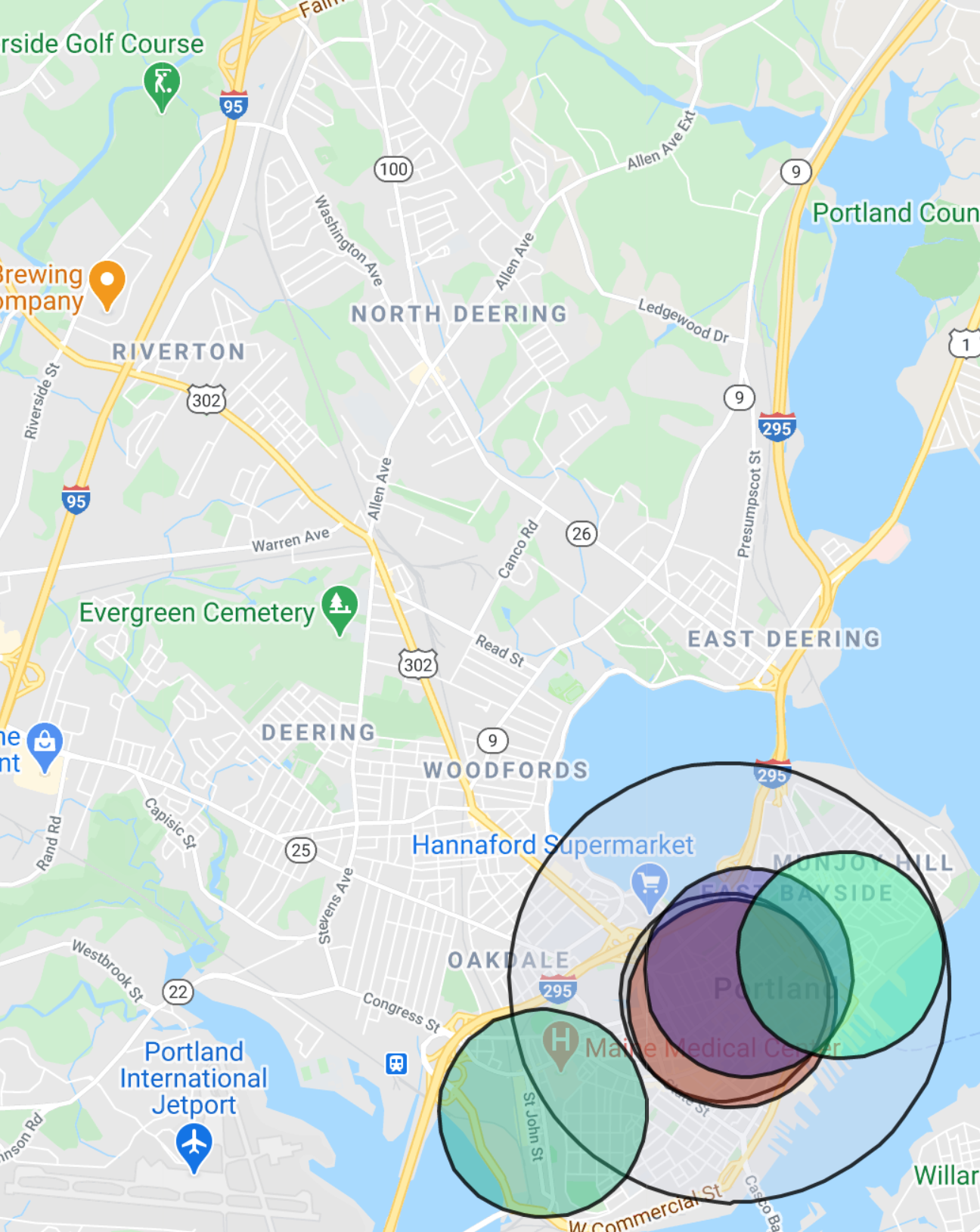
On January 5, 2021, Portland’s Planning Board fast-tracked approval of a new permanent emergency shelter in Bayside. At first blush a public good, this fourth shelter in a 515 foot radius only worsens long-standing inequity and doubles down on the immoral practice of segregating Maine’s lowest socio-economic sector into a designated 0.2 square mile area. It reinforces the fact that the only option for many people seeking shelter is the highest-crime section of Maine’s largest city. It confirms that Bayside residents and businesses are expected to selflessly shoulder much of Maine’s responsibility for addressing homelessness, no matter the cost.

The mere fact of density isn’t itself the problem. Bayside has suffered from both a perpetual lack of foresight in shelter planning and an unwillingness to learn from the past or even acknowledge the reality of the present. This reactive, piecemeal, rudderless approach to shelters has allowed massive community impacts to go unexamined for decades, un-ironically excused as the unavoidable collateral damage of compassion.

The below charts and graphs demonstrate the lack of equity in distribution of emergency shelters in Maine, Cumberland County, and Portland.

This document visualizes data at three points in time:

  • Baseline“– Capacity up to the prior year
  • Add PS– Includes Preble Street’s new Bayside shelter
  • ”Move OSS” – Shows the situation if Portland succeeds in relocating its Oxford Street Shelter to a more appropriate modern facility that has been sited off peninsula

Population

Accounting for population density does not hide the yeoman’s work that Bayside is doing for the rest of Maine. Adding a new emergency shelter within 1000” of three others made that situation somewhat worse (see blue bar in middle row). But even assuming the OSS move comes together (bottom row) – it’s visibly obvious that Bayside residents will still be the primary good samaritans supporting the state’s homelessness solutions.

Bayside’s Per Capita share of emergency beds is currently:

  • 105 times the City’s number of shelter beds
  • 687 times the County’s number of shelter beds
  • 196 times the State’s number of shelter beds

The middle bullet above particularly demonstrates how the rest of Cumberland County passively relies on Bayside, since roughly a third of Portland shelter guests arrive from other towns in the region. Portland also cares for another third with no direct ties to Maine, such as federal asylum seekers. Many thriving suburban municipalities could clearly afford to do their part, especially since there is a state-level reimbursement program already in place that is supposed to be used to respond to the emergency of homelessness where and when it happens. Instead a “skid row” continues to overwhelm one tiny residential neighborhood, while surrounding communities refuse to pay in, and in some cases actively ban homeless shelters.

Geography

Shifting the lens to density of emergency beds per land area, the contrast is so extreme that only a logarithmic scale with units normalized to “emergency beds per 100 square miles” allows all levels to be plotted visibly on the same chart. The rightmost column illustrates that relocating Oxford Street Shelter’s capacity to Riverton would increase the rest of Portland’s share a bit, but barely makes a dent in the super-concentrated quarter mile shelter cluster in Bayside.

Bayside’s per-square-mile share of emergency beds is:

  • 1,575 times the rest of Portland
  • 49,000 times the rest of Cumberland County
  • 83,000 times the rest of Maine

Percentage

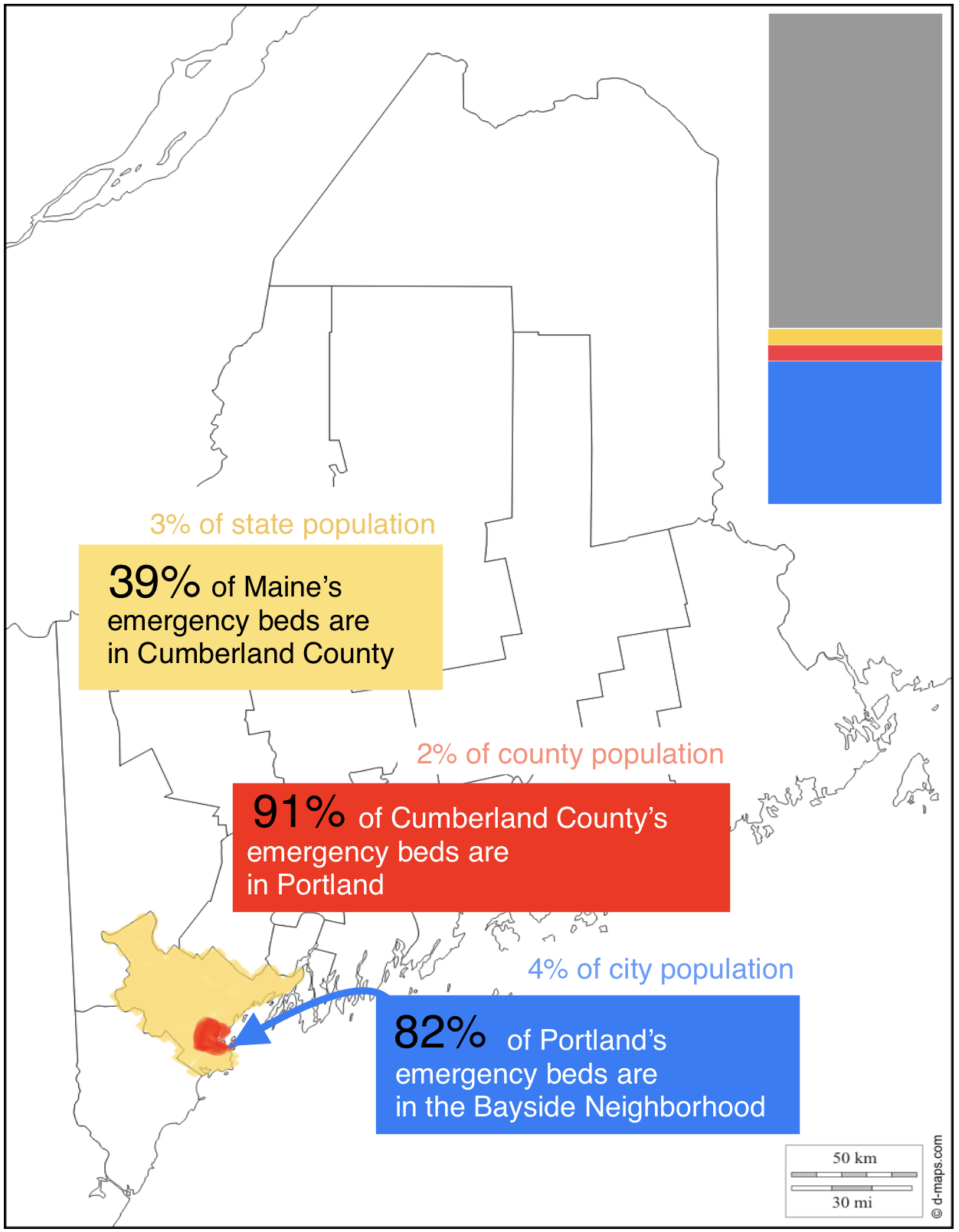
Here is another view that compares % share of Bayside, Portland, Cumberland County, and Maine.
More exhaustive comparison below:

  • Cumberland County provides 39% of Maine’s emergency shelter facilities
  • Portland provides 35% of Maine’s emergency shelter facilities
  • Bayside provides 29% of Maine’s emergency shelter facilities
  • Portland provides 91% of Cumberland County’s emergency shelter facilities
  • Bayside provides 74% of Cumberland County’s emergency shelter facilities
  • Bayside provides 82% of Portland’s emergency shelter facilities
  • All of these are within a 515′ radius, embedded in a poor residential neighborhood
  • Approximately 23% of all Portland police calls for service are in Bayside, and most of those are in the blocks around the shelters

If Portland does move the Oxford Street Shelter off peninsula, Bayside would still continue to provide 16% of all Maine emergency beds, or 210 within less than 0.0006% of Maine’s land mass, inhabited by 0.0002% of Maine’s people, in a neighborhood whose development is vital to Portland’s future.

At the county level, there was at least a recent attempt to help provide some distancing space on county land (still within Portland city limits), but unfortunately the Greater Portland region has not yet succeeded in stepping up to actively participate. The State has contributed to Covid-related safety by funding hotel blocks as shelter during the state of emergency, but pointedly there has been no indication of willingness to materially support Portland’s well researched service center modernization, or provide alternative options.

So, back to equity…

Portland’s Comprehensive Plan embraces the concept of “Equity” – sharing benefits and responsibilities across all the neighborhoods of the city. But despite initiatives like Bayside Boost and expanding emergency shelter zoning almost four years ago, that equity has not been realized. Adding another 40 emergency beds to the current 329 (not including the previous overflow capacity of roughly 200) continues to kick that can down the road. Relocating the Oxford Street Shelter would be a good step, but only a beginning to actual neighborhood balance.

By any measure, at any level, Bayside is propping up the rest of the city, the rest of the county, the rest of the state, and beyond. None of that would matter in the slightest if this model worked to safely, efficiently, and effectively resolve people’s homelessness with minimal impact on the surrounding community. But it doesn’t. It never has. That’s not right, it’s not sustainable, and it’s definitely not equitable.
DATA SOURCES:

Data on location & capacity of emergency beds comes from Portland’s Department of Health and Human Services.

Bayside Emergency SheltersCapacity
• Oxford154
• Family146
• Teen24Previous Baseline324
01/05/21 Approval of new Preble shelter+ 40Bayside Total364
… (If city decommissions Oxford)(– 154)(potential)(210)
Other Portland
• Milestone 41
• Florence House25
• Through These Doors16Other Portland Total 82
… (If city opens Riverton)(+ 200)(potential)(282)
Other Cumberland County
• Tedford (Brunswick)45Other C.C. Total45
Other Maine
(See DHHS list)740Other Maine Total740

Data on population & geography are straight up google-able. Numbers below are from Jan 2021.

Land Area (square miles)PopulationDensity / sq. mi.
• Bayside0.202,68013,400
• Portland7066,600951
• Cumberland County1,200295,000246
• Maine35,0001,344,00038

First Tuesdays: BNA Monthly Meeting

Monthly Board meetings are held the first Tuesday of the month at 6 p.m. As of April 2020 meetings have been held remotely via Zoom. This will continue until CDC guidelines, Portland mandates, and vaccination levels make it safe to meet once agin in our traditional location, the community room at 24 Stone Street in Unity Village.

Meetings are always open to the public and we encourage new friends to attend. All are welcome! This is a great way to find out what’s going on in Bayside, and learn how you can contribute to a safe, vibrant community.

Check the BNA Facebook page for month-to-month changes of time or location and latest news and events.

Fall 2020

Fall 2020 Community Cleanup and Raffle

On Saturday October 24 2020 the BNA held our annual fall community cleanup. We had 34 volunteers, masked up and socially distanced. We managed to clean up just about every street in Bayside. Our helpers included Amistad, their executive director, peer outreach team, and EIGHT of the people they reach; Coals Bayside donated coffee and hosted us in the outdoor dining area to distribute snacks and supplies and two Coals staff members helped with the cleanup. Portland Downtown, BNA board members, and community members also joined in, including new friends from the West End, and old friends from Parkside. Heidi Souerwine designed the posters.

Our generous raffle prize donors included Two Fat Cats Bakery, Leavitt & Sons Deli, Portland, Banded Brewing Co., Nomadic Goat Salon, and BNA board member Scott Morrison, who donated a Coals gift certificate. 

Bylaws Amendment

A proposed amendment to Section 10, Quorum, of the current Bylaws of the Bayside Neighborhood Association shall be voted on by the Board BNA at the Annual Meeting to be held October 17, 2020.  The proposed amendment is bolded:

10) Quorum 

A majority of the Board of Directors shall constitute a quorum for the transaction of business, but a lesser number may adjourn any meeting from time to time, and the same may be held as adjourned without further notice. When a quorum is present at any meeting a majority of the members of the Board present shall decide any question brought before such meeting. Ex-officio Board members will not be included in the count when determining the number needed for quorum, nor be counted when determining if a quorum is present. 

Bayside Community Garden Policy Updates 2020

The Bayside Community Garden (BCG) is a project of the Bayside Neighborhood Association (BNA), a 501(c)(3) non profit advocating for the Bayside neighborhood, which is bounded by Marginal Way, Forest Ave, Congress Street, and Franklin Street. The BCG is located at 78 Chestnut Street on a privately owned parcel that has been temporarily made available for the BNA’s use as a community garden.

The following policies have been put in place for the 2020 gardening season. Gardeners must establish the required roles and plans outlined below to be submitted to the BNA board by April 30, 2020.

POLICIES

Leadership:

Bayside Community Gardeners will establish amongst themselves a management structure that must provide three roles (any of which may be held by the same person):

•An operations manager
•An accountant
•A liaison to the BNA Board

The policies in each area are as follows:

Operations:

One goal of the BCG has been to create a community green space in the midst of a distressed urban neighborhood. This requires that the BCG present an orderly, attractive appearance to gardeners, neighbors, and passersby. To this end the following policies have been developed:

1) The operations manager will oversee the condition of individual plots, according to the following schedule:

June 1 – Plots must be cleared and initial planting completed.
June 15 – Planting for first crops must be complete.
July 1 – A plot must show that it has been consistently maintained.

•If a plot appears abandoned by July 1, the fee will be forfeited and the plot will be offered to the next person on the waitlist at a reduced fee of $20. If there are no takers or the new gardener does not begin planting by July 14 the plot will be cleared and used by the BNA to grow short-season crops for The Locker Project.

•All plots must be consistently maintained for the remainder of the season and closed down appropriately for the off-season.

2) In consultation with the BNA Board a plan must be established detailing where, if anywhere, growth outside of garden plots will be allowed, and what that growth may include for plant material.

•Any such areas must be limited, well maintained, clearly demarcated, and agreed to by the Board.

3) A maintenance schedule for all areas outside the garden plots must be developed, shared with the BNA Board, and adhered to.

•If necessary the BNA board will, at its discretion, correct any overgrowth or plantings outside of approved areas without consultation.

4) The operations manager will ensure that all gardeners understand and agree to these policies.

5) The original mission of creating this garden included increased food security for lower income Bayside residents, especially new Americans. As such:

•Bayside residents will be given first refusal of newly available plots each season, and be put at the top of the waiting list.

Finances

1) The garden accountant will track the balance of plot fees and expenditures:

•Prior to the end of each calendar month, submit to the BNA Treasurer one itemized request for any reimbursements
•Submit a receipt for each garden expenditure
•Distribute reimbursements to individual gardeners. After review and approval by the board (first Tuesday of each month), a reimbursement check will be cut payable to the garden accountant, who will then be responsible for distributing funds to those who paid for expenditures.
•Attend BNA Board meetings as requested

2) The budget for garden expenditures will be the total of the garden fees collected for the 2020 season.

•Assuming all plots are claimed at full fee the 2020 budget is 28 plots x $30 = $840 •Plot fees are non-refundable •The board recommends a sliding-scale model for collecting fees based on need, potentially to be covered by more affluent gardeners. •Any fees collected from gardeners taking over forfeited plots or decreased by sliding scale adjustments will change the total budget. •It is up to garden management to decide how to best utilize available funds within the parameters of these policies.

3) Insurance for the 2020 garden year will be covered by an existing grant to the Avesta garden, a separate garden/greenspace activity of the BNA.

Board Liaison

The Board liaison will communicate with the BNA Board of directors in matters regarding the garden. The liaison will:

•Maintain and share with the Board an updated contact list including plot number, physical address, email and phone numbers of all gardeners.
•Submit to the Board a written monthly report on operations which will include the maintenance schedule, activities and issues in the garden
•Attend board meetings or communicate in other ways as requested.

The goal of these policies is to ensure that the garden enhances the Bayside neighborhood and provides a well-managed and inviting greenspace for all who utilize it. Please feel free to contact me at bnaportland@gmail.com with any questions.

Sarah Michniewicz
President, Bayside Neighborhood Association

BNA Virtual Meetings

In compliance with CDC guidelines, monthly meetings (first Tuesday of the month) are currently being held virtually (via computer/internet) to keep attendees safe and healthy amid the COVID-19 pandemic. Check the BNA Facebook page for month-to-month changes, and email us for a meeting link.  These meetings are always open to the public and we encourage new friends to attend. This is a great way to find out what’s going on in Bayside, and how you can contribute to a safe, vibrant community.  All are welcome!

The “scattered site” model: a history

NOTE:  The following is excerpted, with light edits, from an email from the author to the Portland City Council and other contributors to the effort to plan a new Homeless Services Center to replace the Oxford Street Shelter.  

Despite multiple explorations on the question of scattered vs. consolidated shelters, all of which have come to the same conclusion, the idea that the City of Portland should pay for multiple small emergency shelters persists.  I haven’t been to every meeting on this topic, but I’ve been to a lot, and my own thinking on this question has evolved as I’ve gained new information.  Here are some highlights:

In 2011, a group of dedicated people, including many who worked for organizations that serve the shelter population, and our current City Manager, met for a year as a Homelessness Prevention Task Force, producing this extensive Strategic Plan in 2012:

http://www.portlandmaine.gov/DocumentCenter/View/5496/Strategic-Plan-to-Prevent–End-Homelessness-in-Portland–Nov-2012-Update

It’s a long report, and many people, including myself, relied on news reports and the impressions of experienced stakeholders for a distillation of the key take-aways . One of these take-aways was that scattered, smaller shelters are preferable to a larger shelter.

Despite that impression, in 2015, the City explored teaming up with Preble Street on a consolidated shelter, to be located in Bayside, and the HHS Committee met about it on January 13 and March 10, 2015.  Minutes and packets can be found by going to this page and choosing “View More” on the right and selecting “2015”:

http://www.portlandmaine.gov/agendacenter/hhs-and-public-safety-committee-21/ 

The packet for the March 13, 2015 meeting has a page titled “Proposed Emergency Shelter Consolidation Study” on city letterhead, followed by a sample budget.  (It’s a long packet; this material is about 3/4 of the way through.)  Note the following:

“The study will also revisit data from Preble Street regarding the estimated cost of scattered site shelters from the Homelessness Task Force. Though this model was described as an alternative to a consolidated shelter, the costs appear to be prohibitively high and thus this model may be unrealistic given the current environment.” 

In the wake of this effort and in consideration of funding cuts and obstruction from the state level, the City Council then formed another task force.  My husband, Sean Kerwin, was a member of that task force, whose work included discussion about scattered vs. consolidated shelter models.  This group also faced the reality that the duplication of facilities, staff, and services makes a scattered approach prohibitively expensive, and the task force set to considering best practices.  This group’s work was then brought to an end, since it was apparent that their work would be duplicating much of what the previous task force had already accomplished, and the newly appointed City Manager, Jon Jennings, brought his knowledge and experience as tri-chair of that first task force. This document illustrates the overlap of the two task forces, and it’s useful to see the list of stakeholders who did not pursue the scattered shelter option as a feasible approach:
http://www.portlandmaine.gov/AgendaCenter/ViewFile/Item/2272?fileID=8846

Not only that, but the Strategic Plan actually doesn’t have much to say about scattered shelters being preferable.

In that 25 page plan, there are a few phrases like “other specialty shelters” and “other temporary housing” and “continuum of specialty housing” and “Regionalize the solution to homelessness in Greater Portland.”

What it does clearly recommend is: 

“a centralized intake process through which all clients who are homeless would be assessed…for diversion to housing, other specialized shelters or other housing situations…co-locating all service delivery partners within this centralized intake…”

So the “scattered shelters are better than a single large shelter” position is actually an inaccurate oversimplification of the recommendations of the Strategic Plan.  

(Also, a key element in the small-vs.-big narrative is being glossed over, which is the intake process.  A facility which manages the intake process and emergency housing for newly homeless people provides a different function than one which provides short-term housing for people who are up to speed on the “system” (such as it is) for accessing resources.  But both types tend to get lumped together as a “shelter.”  This blog post by City Councilor Belinda Ray clarifies this to an extent, while giving due credit to other service providers who have partnered with the city on specialty projects.)

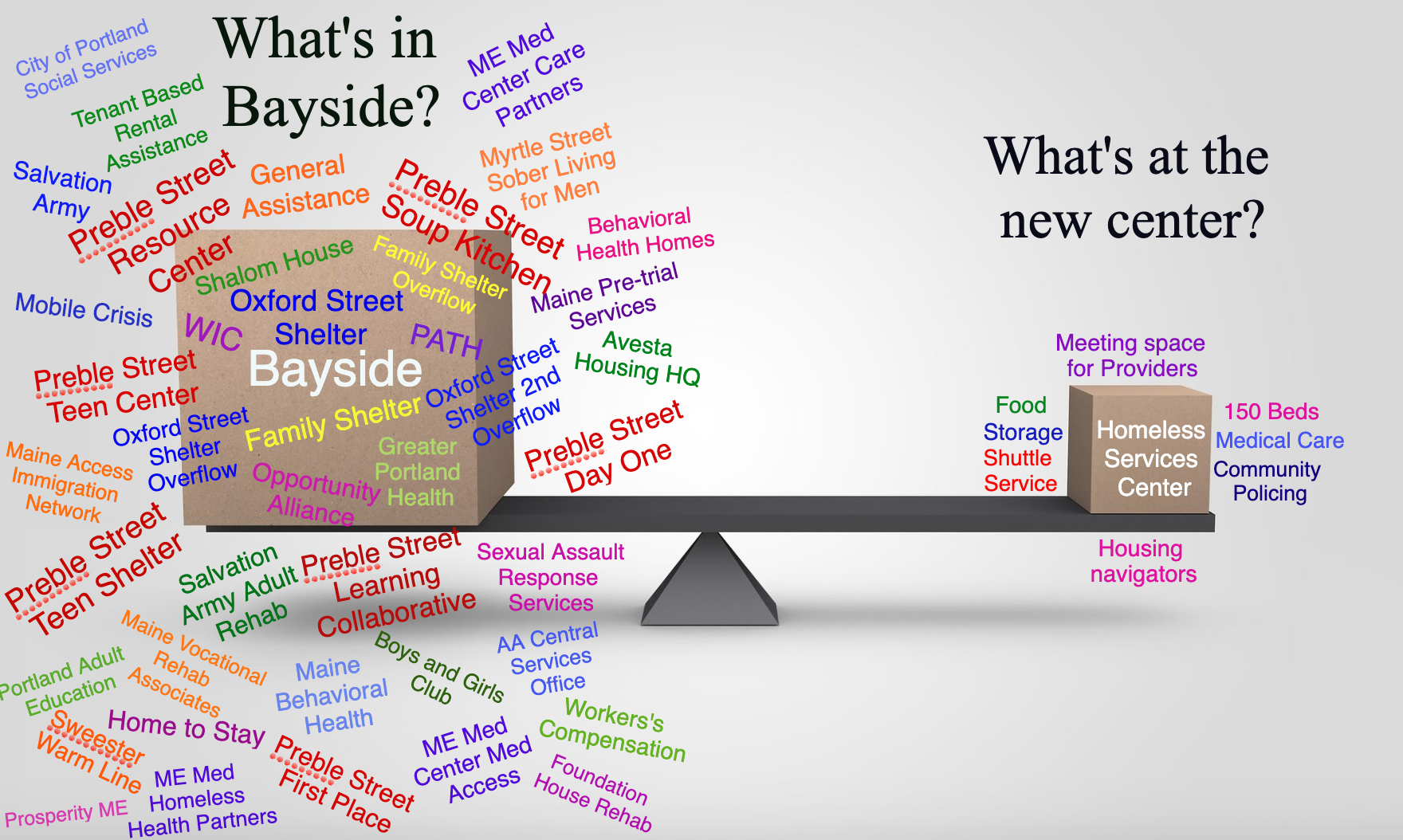
Moreover, my understanding is that the family shelter here in Bayside will remain open, as will Preble Street’s teen shelter (also in Bayside), Florence House, and Milestone.  So we already have some small specialty shelters. They’re just all within a narrow,  2 mile long area on the peninsula.  If the small shelter zoning passes, other “specialty shelters” and “temporary housing” will be enabled across the city.

Given all of this, it’s time for references to smaller shelters to more accurately reflect the intentions of the Strategic Plan and the widely-recognized reality that it’s prohibitively expensive to accomplish the same goals from multiple locations vs. a single location.  More recently, service providers have also expressed concern about clients “falling through the cracks” in a multi-location model.

Opinion: YET ANOTHER TASK FORCE?? AYFKM?!?

[NOTE:  As a site admin, I’m a frequent poster on this web site, but most posts with my byline are on behalf of BNA as a whole, or on behalf of specific individuals as noted.  This one is from my own POV.  – Laura C]

As a resident of Bayside for 10 years, a member of BNA for almost as long, and Vice President of BNA for about 6 years, I’ve spent a fair bit of time at City Hall; in community meetings; in meetings with elected officials and city staff; listening to and in discussion with social services providers from many nonprofit organizations, government agencies, and community initiatives; learning from and working with neighbors who have lived here for decades; and, of course, living in community with people experiencing homelessness.  Does this make me an expert on solutions to homelessness?  No, of course not.  But I know much more than I did 10 years ago, and I wish more people could go through that learning curve more quickly than I did, because that experience counts.

After years of work by a dedicated committee to find a practical solution to Portland’s hopelessly outdated and overwhelmed Oxford Street Shelter, some people without much experience are now calling for…yet…another…task force.  (Sigh.)

We have a task force NOW.  It’s made up of the people who have been showing up for the hard work and hard conversations for years:

  • People who work with homeless and at-risk individuals on a daily basis and know what is needed, in practical terms, to serve this population and empower individuals to take the steps toward long-term positive change.
  • Residents (both long-term and short-term) of Bayside and neighboring communities who have been participating in the public process that has been going on for years, who know what has gone wrong here and are sharing that information in order to get it right.
    • (For those just joining us, it has less to do with “where homeless people belong” and more to do with the density of need and risk, the ratio of long-term residents to transient individuals, a maze of one-way streets, hopelessly inadequate facilities, and a problematic situation that was allowed to fester and grow into a crisis.)
  • People who have devoted their personal time to sit on previous task forces, like this one and this one, and produced work products full of information and recommendations, like this, and who continue to participate in the process.
  • Members of the Health & Human Services and Public Safety Committee and staff of the Health & Human Services department, who have suffered the slings and arrows of public outrage in order to move their work forward, and produced or made visible a significant volume of data, experience, knowledge, and recommendations.
  • Members of the Portland City Council who have attended those Committee meetings, participated in previous iterations of that committee, diligently dug into the work done already, advised on history and policy in order to move the discussion forward, and otherwise invested their own time & energy into understanding the many factors involved in this important decision.

What would a new task force accomplish?  

Aside from interrupting work in progress, delaying practical positive change, and perpetuating a situation many describe as inhumane, what’s wrong with bringing in some “fresh voices?”  What could we expect from such a task force?

  • Unworkable solutions
    Solutions proposed or supported by those in favor of Yet Another Task Force (YATF) include locations in current, active use for incompatible purposes, like fire stations, gyms, and the Portland Expo.  I’ve heard far too many statements that start with “Why don’t they just…” as if there is some simple, obvious solution to the complex and intersecting factors that have led to the current need.
  • Ignorance of the most basic facts and current conditions
    In discussing these issues and this process with those who are new to them, including people pushing for YATF, the number one stumbling block is the need to clarify to people that the Preble Street Resource Center (at 5 Portland Street, and run by one of the largest nonprofit organizations in Maine) IS NOT the Oxford Street Shelter (at 203 Oxford Street, and run by the City of Portland), and/or that these are 2 separate facilities and managing bodies.

    • Another common unproductive conversation is one that starts with the strongly held opinion is that “Housing First is a better solution,” without any knowledge of recent and current Housing First projects, or the fact that most people get into that housing via the emergency shelter.
    • There are real, difficult discussions that need to take place to move this work forward.  We don’t have time to waste on these fundamental misconceptions.
  • Short attention spans
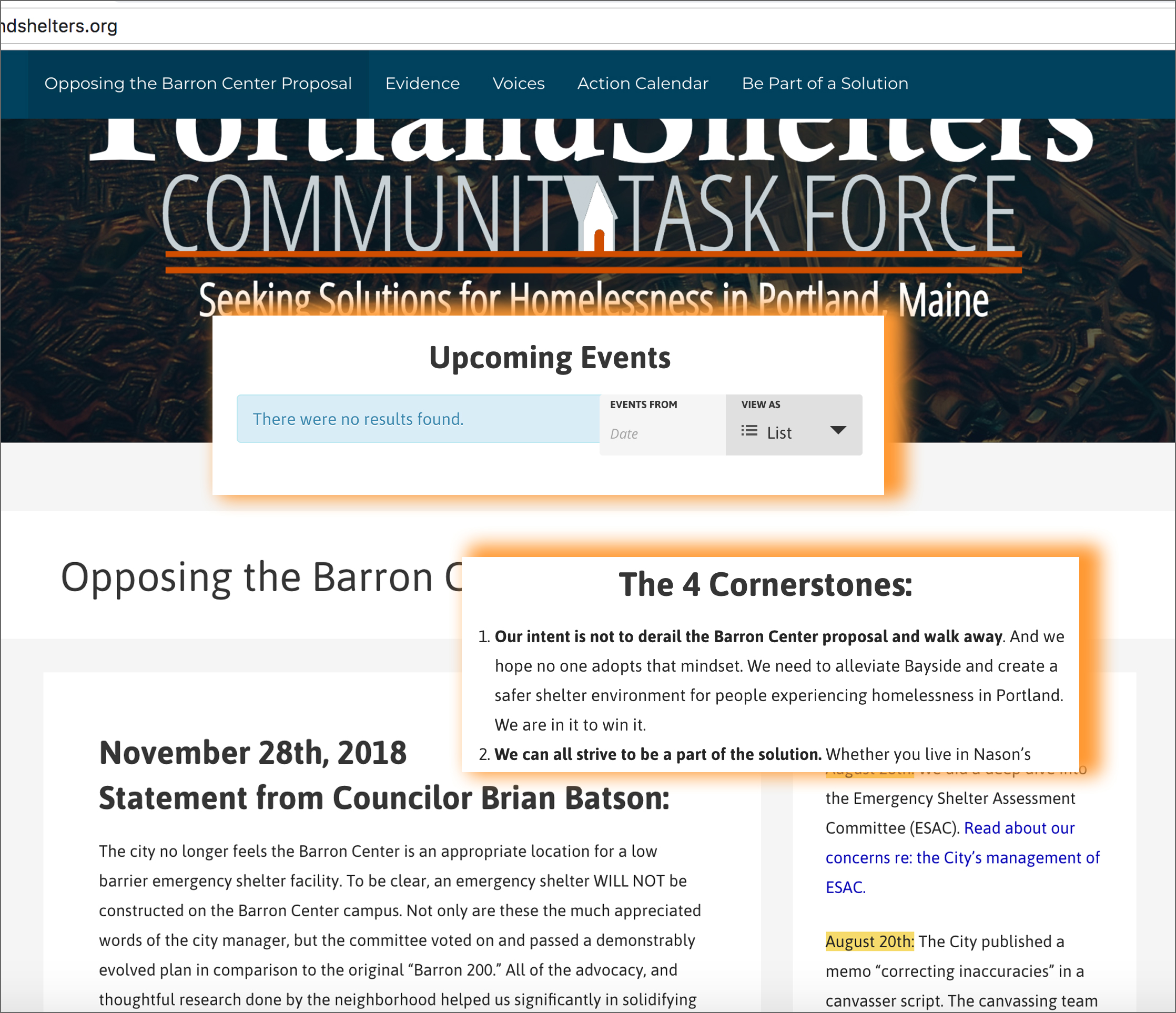
    One group of self-appointed “solution seekers” made a loud & visible fuss early on in the site selection process, and while they promised “Our intent is not to derail the Barron Center proposal and walk away,” they haven’t presented updated information or opportunities to participate since that location was eliminated…such as the Council vote that’s set to take place this month.NIMBY_website
  • Good old run-of-the-mill NIMBYism
    Part of the reason solutions have been long in coming is that there is strong resistance to locating a shelter near…anyone or anything.  No task force is going to change that, and in fact it’s more likely to perpetuate the problem, since the most likely participants of a “diverse, city-wide” resident task force would be residents of the wealthiest residential neighborhoods, who have the time, agency, and motivation to keep such a facility away.  Many people have described this as a “city-wide issue,” but the sad reality is that the vast majority of Portland residents have only gotten involved when a location was proposed nearby.

We don’t need Yet Another Task Force to learn AGAIN what makes these decisions difficult, or to re-hash old arguments and AGAIN come up against the tangible realities that have led to those decisions.  This is, and always has been, a public process; there are more decisions down the road, and anyone with something to offer can contribute to the conversation; that doesn’t require a new task force.

The Portland City Council has the information, resources, and access to expertise and experience that it needs to do its job.  They just have to do it.